CO2 Laser for Medical Industries: 2026 Trends, Applications, and the Precision Optics Behind the Growth
CO2 laser medical technology is booming in 2026—explore the science, applications, market data, and precision ZnSe optics driving this surgical laser trend.
On this page
- Key Takeaways
- The Rise of CO2 Lasers in Modern Medicine
- Why 10.6 Microns: The Science Behind CO2 Laser-Tissue Interaction
- Key Medical Applications Driving Demand
- The Optics Advantage: ZnSe, Germanium, and Beam Delivery Systems
- Key Specifications (WOE CO2 Laser Optics)
- Market Growth and Industry Trends
- What’s Next for CO2 Laser Technology in Healthcare
- How to Prepare
- Conclusion
- Frequently Asked Questions
- What wavelength does a CO2 laser use in medical surgery?
- Why is ZnSe used for CO2 laser lenses?
- How does fractional CO2 laser resurfacing reduce downtime?
- Why can’t CO2 lasers use standard fiber optic cables?
- How big is the medical CO2 laser market?
- Sources
The medical CO2 laser market is on a steady climb, projected to grow from USD 1.2 billion in 2024 to USD 1.8 billion by 2033. Behind every dermatology clinic, dental office, and gynecology suite running CO2 laser surgery sits a chain of precision infrared optics that most buyers never think about—until something fails.
Key Takeaways
- The medical CO2 laser market is forecast to grow at a 5.3% CAGR (2026-2033), fueled by demand in dermatology, dentistry, and gynecology.
- CO2 lasers operate at a 10.6 micron laser wavelength, strongly absorbed by water, giving surgeons highly localized, superficial tissue effects.
- Fractional CO2 laser systems, introduced in 2004, cut recovery time to about a week versus longer downtime for full-field resurfacing.
- Standard fiber optics can’t carry 10.6 micron light, so beam delivery depends on articulated mirror arms, hollow waveguides, and ZnSe lens optics.
- ZnSe remains the industry-standard CO2 laser optics material, achieving over 99.4% transmittance at 10.6 microns.
The Rise of CO2 Lasers in Modern Medicine
CO2 laser medical devices have moved from niche surgical tools to mainstream instruments across multiple specialties. Dermatology, ophthalmology, dentistry, oral surgery, gynecology, otolaryngology, and veterinary medicine all now rely on CO2 laser platforms for precision cutting, ablation, and resurfacing.
The global CO2 laser market overall was valued at USD 3.4 billion in 2025, headed toward USD 5.5 billion by 2034 at a CAGR above 5.5%—with medical and aesthetic demand cited as a key growth driver. A separate, medical-specific market report values the CO2 laser medical segment at USD 1.2 billion in 2024, rising to USD 1.8 billion by 2033.
Note: Some industry reports also cite medical applications at roughly 14% of the broader CO2 laser market, which spans multiple market-sizing definitions and time frames beyond the medical-specific figures above. These two data points come from different research scopes—treat them as independent market signals rather than figures that should be cross-checked against each other.
Why 10.6 Microns: The Science Behind CO2 Laser-Tissue Interaction
The defining feature of CO2 laser surgery is its wavelength: approximately 10.6 microns, deep in the infrared band. This wavelength is absorbed by water roughly 400 times more strongly than an Argon laser—and since tissue is 60-70% water, the energy stays highly localized at the surface.
In oral and dental soft tissue, this means penetration depths of only 30-50 microns. Focusing lenses—commonly ZnSe—produce spot sizes of 80-150 microns in surgical and dental handpieces, enabling submillimeter control.
Dentistry uses three principal CO2 lines:
| Wavelength | Notable Use |
|---|---|
| 9.3 microns | Hard-tissue ablation (isotopic CO2, tuned to hydroxyapatite absorption peak) |
| 9.6 microns | Hard-tissue applications (hydroxyapatite absorption, e.g., cavity prep, apicectomy) |
| 10.6 microns | Traditional soft-tissue cutting, coagulation |
Power delivery modes also shape outcomes. Continuous-wave (CW) surgical lasers run 5-20 W for hemostatic incisions, while superpulse modes hit peak powers of 300-1000 W in 100-300 microsecond pulses at 50-300 Hz. Modern dental systems add high-repetition pulsed modes (>5 mJ, 1-50 microsecond pulses, up to 10 kHz) for hard-tissue ablation, with coagulation zones under 100 microns achievable with proper technique.
Key Medical Applications Driving Demand
- CO2 laser dermatology: Skin resurfacing, lesion removal, and scar treatment using controlled superficial ablation.
- Fractional CO2 laser resurfacing: Splits the beam into microbeams, creating ablation microchannels surrounded by untreated tissue—cutting typical downtime to about a week versus longer recovery for full-field resurfacing.
- CO2 laser dentistry: Soft-tissue cutting and hard-tissue ablation using the 9.3/9.6/10.6 micron lines.
- CO2 laser gynecology: Precision soft-tissue procedures leveraging the laser’s shallow penetration and hemostatic properties.
- Otolaryngology and ophthalmology: Fine incision and ablation work requiring tight beam control.
- Veterinary medicine: Soft-tissue surgery and lesion removal benefiting from the same hemostatic, superficial ablation properties used in human dermatology.
Note: CO2 laser resurfacing requires a trained healthcare team—typically a licensed dermatologist, otolaryngologist, plastic surgeon, or oral surgeon, often supported by trained physician assistants or nurses.
The Optics Advantage: ZnSe, Germanium, and Beam Delivery Systems
CO2 lasers generate their beam in a gas discharge mixture of CO2, helium, and nitrogen (sometimes with added hydrogen, water vapor, or xenon). Nitrogen molecules are vibrationally excited by the discharge and transfer energy to CO2 molecules, while helium depopulates the lower laser level and dissipates heat.
Because standard silica fibers can’t transmit 10.6 micron light, delivery depends on articulated mirror arms or hollow-core waveguides rather than conventional fiber optics—making every mirror, lens, and window in the beam path critical to system performance.
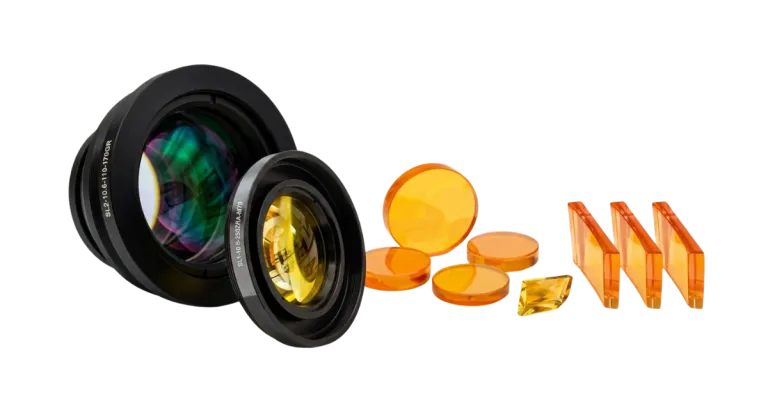
As a CO2 laser optics manufacturer, Wavelength Opto-Electronic (WOE) builds infrared surgical laser optics around zinc selenide (ZnSe), the industry-standard material for CO2 wavelengths due to its low bulk absorption at 10.6 microns. Germanium is also used in CO2 systems but is more thermally sensitive. ZnSe’s unique advantage: it’s the only common CO2 optical material that also transmits visible light—essential for passing a visible aiming beam through the same optic as the invisible 10.6 micron beam.
Key Specifications (WOE CO2 Laser Optics)
| Parameter | Specification |
|---|---|
| Material | ZnSe |
| Clear aperture | >90% |
| Surface flatness | λ/4 per 1-inch diameter (at 632.8 nm) |
| Surface quality | 60-40 scratch-dig |
| Coating reflectance (per surface) | <0.2% at 10.6 microns |
| Transmittance | >99.4% at 10.6 microns |
| Angle of incidence | Brewster angle for 10.6 micron operation |
These specs matter directly for surgical outcomes: low reflectance and high transmittance preserve beam energy for consistent incision depth, while tight flatness and surface quality reduce scatter and thermal lensing during high-repetition pulsed use. ZnSe laser windows also protect downstream optics in high-power CO2 systems.
Market Growth and Industry Trends
- Medical CO2 laser market: USD 1.2B (2024) → USD 1.8B (2033), 5.3% CAGR calculated over the 2026-2033 period.
- Overall CO2 laser market: USD 3.4B (2025) → USD 5.5B (2034), >5.5% CAGR.
- Medical/aesthetic share: cited at roughly 14% of the broader overall CO2 laser market in some industry reports, alongside larger industrial material-processing segments—note this figure uses a different market scope than the medical-specific valuation above.
- Fractional delivery systems, introduced in 2004, remain a major growth driver by shortening recovery time and expanding aesthetic use cases.
What’s Next for CO2 Laser Technology in Healthcare
Expect continued refinement rather than wholesale reinvention. Isotopic CO2 lasers tuned to 9.3 microns for hydroxyapatite absorption point toward more wavelength-specific hard-tissue systems in dentistry. Pulsed and superpulse modes will keep pushing peak power and repetition rates for finer ablation control with less collateral thermal damage. On the optics side, coating technology pushing transmittance beyond 99.4% and tighter surface tolerances will keep enabling smaller spot sizes and more predictable coagulation zones.
How to Prepare
- Match wavelength to application—9.3/9.6 micron for hard tissue, 10.6 micron for soft tissue and resurfacing.
- Specify optics, not just laser power—transmittance, coating reflectance, and surface quality directly affect clinical outcomes.
- Plan beam delivery early—mirror arms or hollow waveguides, not fiber, are required for 10.6 micron systems.
- Work with an experienced CO2 laser optics manufacturer to source ZnSe lenses and windows built to surgical-grade tolerances.
Conclusion
CO2 laser medical technology continues to expand across dermatology, dentistry, gynecology, and beyond, backed by steady market growth and improving precision optics. As fractional and pulsed delivery systems push clinical capabilities further, the ZnSe lenses, windows, and coatings behind the beam path matter as much as the laser source itself. Wavelength Opto-Electronic (WOE) designs and manufactures precision ZnSe CO2 laser optics built for these demanding surgical requirements. Visit wavelength-oe.com to discuss your CO2 laser optics needs with our team.
Frequently Asked Questions
What wavelength does a CO2 laser use in medical surgery?
Medical CO2 lasers emit primarily at approximately 10.6 microns, in the infrared band, though dental systems also use 9.3 and 9.6 micron lines depending on the tissue target.
Why is ZnSe used for CO2 laser lenses?
ZnSe has low bulk absorption at 10.6 microns and is the only common CO2 optical material that also transmits visible light, allowing a visible aiming beam to share the same optical path as the invisible laser beam.
How does fractional CO2 laser resurfacing reduce downtime?
Fractional systems split the beam into many microbeams that create ablation microchannels surrounded by untreated tissue, speeding healing and cutting typical recovery to about a week compared to longer downtime for full-field resurfacing.
Why can’t CO2 lasers use standard fiber optic cables?
Standard silica optical fibers do not transmit 10.6 micron light, so CO2 surgical lasers deliver their beam through articulated mirror arms or hollow-core waveguides instead.
How big is the medical CO2 laser market?
The medical CO2 laser market was valued at USD 1.2 billion in 2024 and is projected to reach USD 1.8 billion by 2033, growing at a 5.3% CAGR over 2026-2033. This figure comes from a medical-specific market report and is separate from broader estimates of medical/aesthetic share within the total CO2 laser market.
Sources
- wavelength-oe.com/co2-laser-optics (https://www.gminsights.com/industry-analysis/co2-laser-market)
- lucintel.com/co2-laser-market.aspx
- marketresearchfuture.com/reports/co2-lasers-market-10008
- verifiedmarketreports.com/product/medical-co2-laser-market
- businessresearchinsights.com/market-reports/co2-laser-mar…