Laser Optics | Ronar-Smith
Ronar-Smith F-Theta Scan Lenses: Standard and Telecentric
Ronar-Smith f-theta scan lenses for laser marking, cutting and engraving: standard, telecentric and achromatic designs. Get a quote from Wavelength Optics USA.
Catalogue part numbers
CO2 laser optimized versions
Standard and telecentric designs
Designs to your specification
Full catalogue
0 matching parts
| Part Number▲ | Product Type▲ | Wavelength (nm)▲ | EFL (mm)▲ | Scan Field (mm x mm)▲ | Input Beam Dia (1/e2) (mm)▲ | F-Theta (Standard or Telecentric)▲ | Material▲ | Mounting Thread▲ | WD (mm)▲ |
|---|
No parts match these filters. .
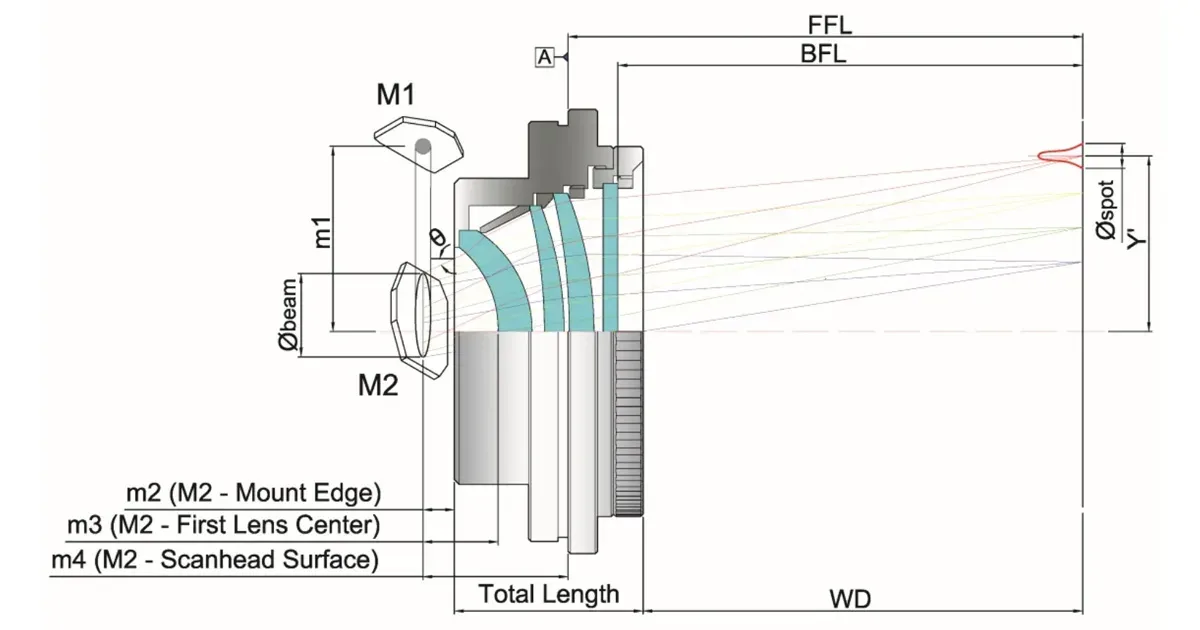
Ronar-Smith® f-theta scan lenses focus a galvo-scanned laser beam onto a flat field, with spot displacement linear to scan angle. Whether you’re marking serial numbers on machined parts, engraving packaging, or cutting thin materials, the lens keeps the focal plane flat across the scan area so your scan head software can map angle directly to position. The catalogue covers standard, telecentric, achromatic and CO2-optimized designs in fused silica, optical glass and ZnSe. Anti-reflective coatings reduce reflection losses, and custom designs are available when a catalogue part doesn’t fit your system.
How f-theta lenses work in a scanning system
A conventional focusing lens places the focal spot on a curved surface, and the spot position follows the tangent of the scan angle. In a galvanometer scanning system, that produces defocus toward the edges of the field and a nonlinear position map. An f-theta lens corrects both: it flattens the image field and makes image height proportional to the product of focal length and scan angle. The result is consistent focus and predictable beam placement across the full scanning range, which simplifies calibration and improves repeatability in laser cutting, marking and engraving.
Configurations
- Standard f-theta. Flat-field focusing for general laser marking, engraving and cutting where a small angle of incidence at the work surface is acceptable.
- Telecentric f-theta. The chief ray meets the work surface close to normal across the field, so spot size and imaging resolution stay consistent from center to edge. This matters when you’re drilling or cutting holes that need straight walls, processing semiconductor or electronics substrates, or running a coaxial camera through the scan head for machine vision alignment.
- Achromatic f-theta, standard and telecentric. Corrected for use with two wavelengths, useful when a processing laser shares the optical path with a visible pointer or an inspection channel.
- CO2 laser lenses for 9.4/10.6μm. ZnSe designs, including doublet and triplet versions and a telecentric option, for CO2 marking and cutting of polymers, wood, paper, glass and other non-metals.
Across the range, lenses are offered for laser sources from the ultraviolet through visible and near-infrared fiber and solid-state lasers to the far infrared. Focal length, scan field, input beam diameter, working distance and mounting thread vary by part; the specification table on this page lets you filter all of them.
Choosing the right lens
Start from your laser wavelength and the input beam diameter coming out of your scan head, then decide on the field size you need. Focal length sets the trade-off: a longer focal length gives a larger scan field and longer working distance, while a shorter one gives a smaller focused spot for finer features. If your process depends on uniform spot size or perpendicular incidence across the field, as in precision drilling, fine cutting or vision-guided processing, a telecentric design is usually the better fit. Material follows wavelength: fused silica suits ultraviolet and high-power applications, optical glass covers many visible and near-infrared systems, and ZnSe is used for CO2 lasers. Check the mounting thread against your scan head before ordering.
Why buy through Wavelength Optics USA
Wavelength Optics is the US arm of Wavelength Opto-Electronic, the Singapore manufacturer behind Ronar-Smith® optics. Buying through the US entity gives you:
- Local support in your time zone, from engineers who know the product line.
- Fast quoting on catalogue parts and custom requests.
- Technical consultation on selection, including matching focal length, scan field and configuration to your scan head, laser source and process.
If no catalogue lens fits your system, send your wavelength, beam diameter, field size, working distance and mounting requirements through the RFQ form and we’ll review a custom design with you.
Need Help Choosing the Right Model?
Our photonics specialists can help you select the optimal configuration for your system. Custom specifications available on request.