Microscopy | Objectives & Tube Lenses
Microscope Objective Lenses: Apochromatic, Infinite Optical System
Apochromatic infinite microscope objective lenses, eyepiece objectives and tube lenses for 355nm to 1064nm. Request a quote from Wavelength Optics USA today.
Spectral region covered across the family
Correction class of the objective lenses
Objectives pair with a matched tube lens
Design request service for non-catalogue needs
Full catalogue
0 matching parts
| Part Number▲ | NA▲ | WD (mm)▲ | FL (mm)▲ | Resolution (µm)▲ | ± DOF▲ | Wavelength (nm)▲ | FOV φ24 mm▲ | FOV 1" CCD (mm)▲ | Weight (g)▲ | ± DOF (μm)▲ | Field Number▲ | FOV (mm)▲ | Thread▲ |
|---|
No parts match these filters. .
Wavelength microscope objective lenses gather and focus light from the specimen to produce a magnified image with minimal aberration. The family consists of apochromatic, infinite optical systems offered in several magnifications. It spans the spectral region from 355nm to 1064nm. Whether you’re building coaxial vision into a laser processing head or setting up a fluorescence inspection station, you can select objectives, eyepiece objectives and a matched tube lens from one source and specify them as a single optical train.
What’s in the family
Microscope objective lenses. These apochromatic objectives are designed as infinite optical systems. Light leaving the objective travels as parallel rays, which leaves room in the optical path for beam splitters, filters and laser coupling optics without shifting the image plane. Some part numbers include a ‘t’, which indicates the cover glass thickness the objective is corrected for. Check this against your sample preparation or protective window before you order.
Eyepiece objective lenses. These are offered alongside the infinite objectives for systems that need direct visual observation.
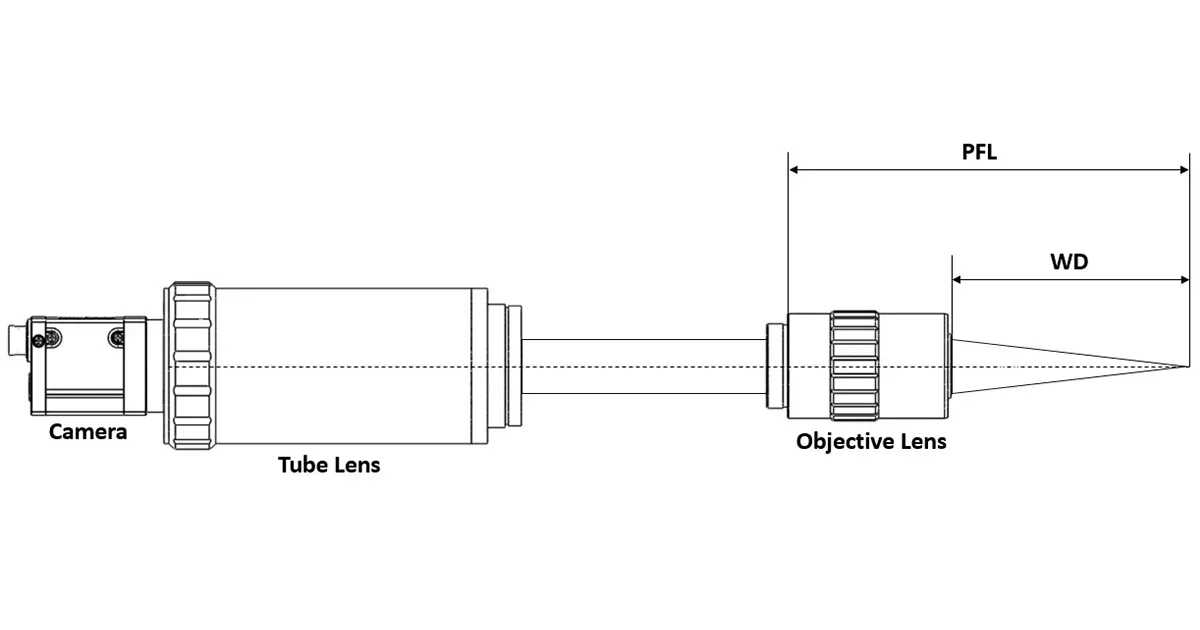
Tube lens. The tube lens works together with the objective. It takes the parallel rays from the objective and focuses them to form an intermediate image with minimal aberration. Pairing a Wavelength objective with the matching tube lens gives you a defined imaging path for camera-based systems.
The spec table on this page lists each part by numerical aperture, working distance, focal length, resolution, depth of focus, design wavelength, field of view, field number, thread and weight. You can filter it to narrow candidates for your application.
Applications
The infinite design and broad spectral coverage make these objectives suited to coaxial vision in real-time monitoring, where the same optic images the work area and delivers or observes the process:
- Laser processing. Use these objectives for coaxial monitoring and focusing in micromachining and micro-welding setups.
- Laser repair of touch panels and solar cells. You can locate defects and direct the repair laser through a shared optical path.
- Semiconductor and silicon wafer inspection. These objectives support micro-imaging of fine features on production and R&D tools.
- DIC imaging. The objectives fit differential interference contrast systems that need contrast on transparent or low-relief samples.
- Biomedical fluorescence inspection. Apochromatic correction supports imaging across multiple excitation and emission bands.
Selecting the right objective
Start with your laser or illumination wavelength and confirm it sits within the design wavelength listed for the part. Then balance numerical aperture against working distance. Higher NA improves resolution but generally reduces working distance and depth of focus, which matters if you need clearance for a nozzle, gas assist or a sloped part. Next, confirm field of view against your sensor format and check the mounting thread against your turret or adapter. Finally, account for any cover glass or window in the path by choosing the correct ‘t’ variant.
If no catalogue part fits your requirements, customization is available. Wavelength provides a design request form for objective lenses that captures your wavelength, magnification, working distance and mechanical constraints.
Why order through Wavelength Optics USA
Wavelength Optics is the US arm of Wavelength Opto-Electronic, the Singapore manufacturer that designs and produces these lenses. Working with the US team gives you:
- Local support in your time zone, from first inquiry through integration.
- Fast quoting for catalogue parts and custom design requests.
- Technical consultation on selection. We can help you choose NA, working distance and the ‘t’ variant, pair the objective with a tube lens, and plan the combination with filters, beam expanders or scan optics elsewhere in your system.
Send us your wavelength, required resolution and mechanical envelope. We’ll recommend candidate parts or start a custom design request.
Need Help Choosing the Right Model?
Our photonics specialists can help you select the optimal configuration for your system. Custom specifications available on request.