Mirrors · Parabolic Reflectors
Off Axis Parabolic Mirrors: Diamond-Turned Aluminium & Copper
Diamond-turned off axis parabolic mirrors in aluminium or copper, off-axis angles 15°-90°, custom coatings. Request a quote from Wavelength Optics USA.
Off-axis angle range
Focal length tolerance
Surface quality
Aluminium or copper substrate
Full catalogue
0 matching parts
| Part Number▲ | Diameter (mm)▲ | Reflection Angle (°)▲ | Reflective Focal Length (mm)▲ | Coating▲ | Remarks▲ |
|---|
No parts match these filters. .
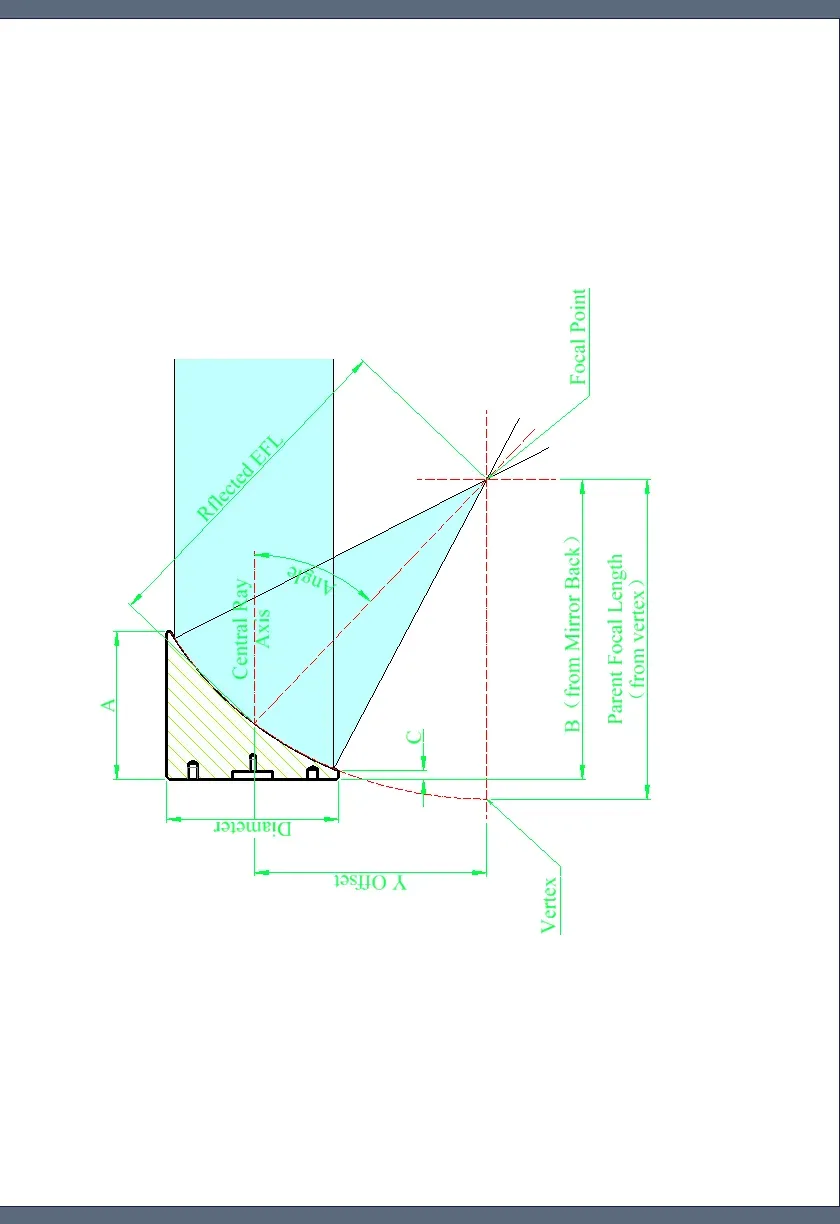
Off axis parabolic mirrors focus incoming collimated light to a single focal point, or collimate light from a point source, using a parabolic surface profile. Because the focal point sits off the optical axis of the incoming beam, you get clear access to the focus for a detector, fiber tip or sample without obstructing the beam path. Wavelength Optics supplies these mirrors diamond turned in aluminium or copper, with off-axis angles from 15°-90° and a range of coating options, so you can match the reflector to your geometry and wavelength rather than working around a fixed part.
How an off-axis parabola works in your system
A parabolic surface brings collimated light to focus without the spherical aberration you would get from a spherical mirror. The off-axis section moves the focal point away from the incoming beam, which matters when you need physical space around the focus. The approach works best when beam divergence is small, so it suits well-collimated laser beams and light from distant or point-like sources.
Because focusing is done by reflection rather than refraction, there is no lens material in the beam path. That makes these mirrors useful when you are working across a broad spectral band or at wavelengths where suitable transmissive materials are limited. The usable band in practice depends on the coating you specify.
Typical uses include:
- Fiber coupling and collimation: focusing a collimated beam into a fiber, or collimating fiber output for free-space optics in laser processing and test setups.
- Spectroscopy: collimating and refocusing light in spectrometer and FTIR-style layouts where a lens would add dispersion.
- Telescopes and retroreflectors: reflective collection and focusing in imaging and alignment instruments.
- Lighting and solar applications: concentrating or directing light where a reflective element is preferred.
Diamond-turned manufacturing and options
Each mirror is produced by single-point diamond turning, which forms the parabolic profile directly in the metal substrate. Standard parts are specified with a focal length tolerance of ±1%, a clear aperture of >90%, and surface quality of 40-20 S-D.
You can choose between aluminium and copper substrates. Aluminium is lightweight and easy to integrate into compact assemblies. Copper is often chosen where thermal conductivity matters, for example in setups handling higher optical power. Coatings are available to suit the wavelength band and environment of your application. Our team can help you select one.
The catalogue covers a range of diameters, reflection angles and reflective focal lengths. The full specification table on this page lets you filter by these parameters to find a standard part that fits your layout.
Custom parabolic mirrors
If a catalogue part doesn’t fit your design, diamond turning allows customization of surface roughness, coatings and off-axis angle. Send your requirements through the RFQ form, including focal length, aperture, angle, substrate and operating wavelength, and we’ll review feasibility with you.
Why order through Wavelength Optics USA
Wavelength Optics is the US arm of Wavelength Opto-Electronic, the Singapore manufacturer that produces these mirrors. Ordering through the US entity gives you:
- Local support: a US-based contact for questions, documentation and order follow-up, working in your time zone.
- Fast quoting: send a part number or a custom specification and get a quote without routing the request overseas yourself.
- Technical consultation on selection: help choosing off-axis angle, focal length, substrate and coating for your beam geometry, whether you’re coupling a fiber laser, building a spectrometer or setting up a machine vision or semiconductor inspection path.
For standard parts, use the specification table to identify a part number and request a quote. For custom geometries or coatings, contact Wavelength Optics USA with your specification and we’ll work through the details with you.
Need Help Choosing the Right Model?
Our photonics specialists can help you select the optimal configuration for your system. Custom specifications available on request.