Imaging Lenses · Laser Focusing
Spherical Lenses: Glass and ZnSe Focusing Lenses for Laser Systems
Spherical lenses in BK7, fused silica and ZnSe for focusing laser beams, with air-spaced and achromatic cemented options. Ask Wavelength Optics USA for a quote.
Catalogue part numbers
Achromatic doublets, color corrected for visible
Substrate options across wavelength bands
Specifications built to your RFQ
Full catalogue
0 matching parts
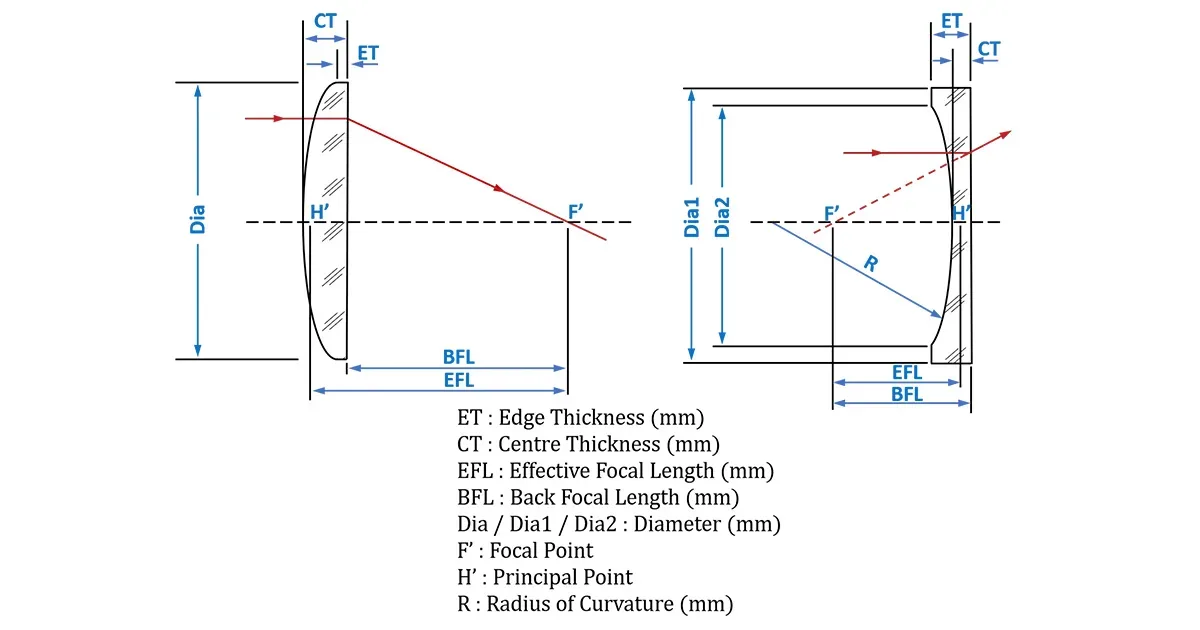
| Part Number▲ | Wavelength (nm)▲ | Diameter (mm)▲ | EFL (mm)▲ | Material▲ | Assembly▲ | ET (mm)▲ | Product type▲ | CT (mm)▲ | BFL (mm)▲ |
|---|
No parts match these filters. .
Spherical lenses take a collimated laser beam and focus it to a small, precise spot by changing the curvature of the wavefront passing through the lens. Wavelength’s spherical lens range covers optical glass (BK7 and fused silica) and ZnSe, in single-element, air-spaced and achromatic cemented configurations. That range lets you match the lens to your laser source, your working distance and whether your system also needs to image the process. Whether you’re specifying the final focusing optic on a fiber-laser cutting head or replacing the lens on a CO2 engraver, the catalogue gives you a starting point. Custom builds are available when a standard part doesn’t fit.
Glass and ZnSe: choosing the substrate
Glass spherical lenses are made from BK7 or fused silica and are used where your laser wavelength sits in the range those materials transmit. Different coatings and materials are offered for different wavelengths, so you can pair the substrate and AR coating with your source rather than settling for a general-purpose part. Typical uses include engraving graphic images, welding metal parts and cutting a wide variety of materials.
ZnSe lenses serve the infrared, including CO2 laser systems. Three ZnSe geometries are available:
- Plano-convex: positive focal length, focuses a collimated beam to a small spot. Mount it with the curved surface facing the source to minimize spherical aberration.
- Plano-concave: negative focal length, diverges a collimated beam. Again, the curved surface should face the source.
- Positive meniscus: a converging lens, thicker at the center than at the edge, with the concave radius greater than the convex radius. With the convex side facing the source, it is designed to minimize spherical aberration and give the smallest focal spot for incoming collimated light.
The catalogue also lists other infrared and UV materials, including CaF2, Si and ZnS. The full spec table on this page shows which material, diameter and focal length combinations are standard.
Air-spaced and achromatic designs
A single spherical element has limits on how tightly it can focus. Air-spaced glass lenses were developed to reduce aberration and reach a smaller spot. The achromatic triplet versions are also color corrected, so your working laser beam and your visible inspection beam come to the same focus, or to two closely spaced points.
Achromatic cemented doublets combine a low-dispersion crown glass element with a high-dispersion flint glass element. They are designed for 1064 nm lasers and color corrected for the visible. That makes them a practical choice for laser cutting and welding heads with a coaxial vision system. Your camera sees the process in focus while the laser stays on target, without separate refocusing.
Both the ZnSe and glass lens series are produced to published tolerances on diameter, thickness, focal length, edge thickness variation, clear aperture, surface flatness and surface quality. Coating options for the glass series span from the UV to the near infrared. Refer to the specification table for per-part values.
Why order through Wavelength Optics USA
Wavelength Optics is the US arm of Wavelength Opto-Electronic, the Singapore manufacturer that designs and produces these lenses. Buying through the US entity gives you:
- Local support in your time zone, with a US point of contact for orders, follow-up questions and replacement parts.
- Fast quoting on catalogue parts and custom configurations. Send your wavelength, beam diameter and focal length requirements and we’ll come back with options.
- Technical consultation on selection. If you’re deciding between a single-element lens, an air-spaced design or an achromatic doublet, or between glass and ZnSe, our engineers can work through the tradeoffs with you: spot size, working distance, aberration and vision-system compatibility.
If your application needs a non-standard diameter, focal length, material or coating, tell us your specifications through the RFQ form and we’ll review feasibility with the factory.
Need Help Choosing the Right Model?
Our photonics specialists can help you select the optimal configuration for your system. Custom specifications available on request.