Why 10.6 µm F-Theta Optics Matter in CO₂ Laser Polishing of Fused Silica
How F-theta lenses enable precise CO2 laser polishing of fused silica—covering design, transmission, and why WOE optics deliver flat-field accuracy.
On this page
- Key Takeaways
- Fundamentals: What Are F-Theta Lenses?
- How It Works: CO₂ Lasers and 10.6 Micron Optics
- Refractive Index and Transmission Considerations
- Key Types / Variations: F-Theta vs Standard Focusing Lenses
- Telecentric F-Theta Lens
- Applications
- Key Considerations
- Conclusion
- Frequently Asked Questions
- What are F-theta lenses?
- What is the best lens for a CO2 laser?
- Why use an F-theta lens in CO2 laser material processing?
- What is the wavelength of a CO2 laser?
- Which way does the lens go in a CO2 laser?
Polishing fused silica with a CO₂ laser demands more than raw power—it demands optics that keep the beam focused and flat across the entire work area. An F-theta lens for CO2 laser polishing fused silica applications is the component that makes this possible, and choosing the wrong one undermines even the best laser source.
This explainer covers how these lenses work, what makes 10.6 µm optics different from standard focusing lenses, and what to check before specifying optics for a glass-polishing or resurfacing system.
Key Takeaways
- F-theta lenses deliver a flat, linear focal plane across a scan field—critical for uniform CO₂ laser polishing of fused silica.
- Wavelength matters: CO₂ lasers emit at 10.6 µm, so lens materials and coatings must be optimized specifically for that infrared band.
- Material choice (typically ZnSe or GaAs-based optics) directly affects transmission efficiency and thermal stability during polishing.
- Telecentric F-theta designs keep the beam perpendicular to the work surface, improving polish uniformity at the field edges.
- Standard focusing lenses introduce field curvature and spot distortion that F-theta designs are built to eliminate.
Fundamentals: What Are F-Theta Lenses?
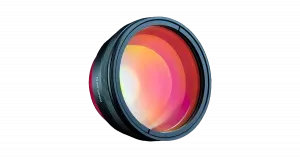
An F-theta lens is a specialized scan lens used in laser systems with a moving (galvo) mirror. Instead of focusing to a curved surface like a conventional lens, it maps the scan angle directly and linearly onto position on a flat plane—hence “F-theta” (focal length × theta angle = image height).
What does an F-theta lens do? It corrects field curvature and keeps the focal spot size and position consistent as the beam scans across the work surface. Without it, the edges of a scanned area would be out of focus while the center stays sharp—unacceptable for polishing applications where uniform surface finish is the goal.
How It Works: CO₂ Lasers and 10.6 Micron Optics
What is the wavelength of a CO2 laser? CO₂ lasers operate at 10.6 µm, deep in the infrared. This long wavelength is strongly absorbed by fused silica, which is exactly why CO₂ lasers are effective for smoothing and resurfacing glass surfaces at the micro and macro scale—the energy is absorbed at the surface, softening and flowing the glass to reduce roughness.
Because the beam must scan across a work field—rather than stay fixed—the optical train needs:
- A galvanometer scan head to steer the beam in X-Y.
- An F-theta lens to keep focus flat and spot size consistent across that scan field.
- Lens materials transparent at 10.6 µm (commonly ZnSe or germanium-based elements, sometimes GaAs), since standard visible-wavelength glass optics do not transmit CO₂ laser light efficiently.
Which way does the lens go in a CO2 laser? Orientation matters: F-theta lenses are directional, with the curved or coated surface typically facing the incoming scanned beam and the flatter working side facing the workpiece. Incorrect orientation increases aberration and reduces focus quality—always follow the manufacturer’s mounting diagram.
Refractive Index and Transmission Considerations
For f-theta lens for CO2 laser polishing fused silica refractive index performance, the lens material’s index at 10.6 µm governs focal length calculations and coating design. High f-theta lens for CO2 laser polishing fused silica transmission is essential—every percentage point of absorbed or reflected energy at this wavelength becomes heat in the lens itself, risking thermal lensing and drift during long polishing runs. Anti-reflection coatings tuned specifically for 10.6 µm are standard practice to maximize throughput and protect the optic.
Key Types / Variations: F-Theta vs Standard Focusing Lenses
| Feature | F-theta Lens | Standard Focusing Lens |
|---|---|---|
| Focal plane | Flat across scan field | Curved (field curvature) |
| Spot consistency | Uniform across field | Degrades toward edges |
| Scan compatibility | Designed for galvo scanning | Designed for fixed-beam focusing |
| Best for | Large-area polishing, resurfacing | Single-point drilling, cutting |
| Telecentricity | Available (telecentric variants) | Not applicable |
F-theta vs standard focusing lens for laser polishing glass comes down to this: a standard lens can produce a sharp spot at the center of a field, but polishing requires consistent spot size and angle of incidence everywhere the beam travels. That’s the core reason F-theta design exists.
Telecentric F-Theta Lens
A telecentric F-theta lens goes a step further, keeping the beam perpendicular to the work surface across the entire scan field rather than converging at an angle. For polishing fused silica, this reduces asymmetric heating and improves finish uniformity at the edges of large parts.
Applications
- CO₂ laser glass polishing equipment for optical component finishing.
- Fused silica resurfacing in semiconductor and photonics manufacturing.
- Micro-smoothing of etched or machined glass surfaces before coating.
- Edge and surface defect removal on precision optical substrates.
Key Considerations
- Wavelength-specific coatings: confirm optics are rated for 10600nm, not just generic “IR” coatings.
- Field size vs working distance: match lens specifications to your scan head and part dimensions.
- Thermal management: high transmission reduces lens heating during extended polishing cycles.
- Mounting orientation: installing an F-theta lens backward degrades spot quality—always check the datasheet diagram.
- Telecentricity needs: required when uniform incidence angle across large parts matters more than compact lens size.
Tip: When evaluating best optics for CO2 laser glass polishing equipment, ask suppliers for transmission and spot-size data specifically at 10.6 µm across the full scan field—not just at center field.
Conclusion
Effective CO₂ laser polishing of fused silica depends on matching laser wavelength, scan architecture, and lens design. A properly specified F-theta lens for CO2 laser polishing fused silica glass keeps focus flat, spot size consistent, and transmission high across the entire work field—delivering the uniform finish that polishing and resurfacing applications require.
Wavelength Optics designs and manufactures precision infrared optics, including F-theta lens solutions engineered for 10.6 µm CO₂ laser systems. If you’re specifying optics for a glass-polishing or resurfacing platform, contact us to discuss your application requirements.
Frequently Asked Questions
What are F-theta lenses?
F-theta lenses are scan lenses used in galvanometer-based laser systems that map scan angle linearly onto a flat focal plane, keeping spot size and focus consistent across the entire work area rather than only at the center.
What is the best lens for a CO2 laser?
For scanning applications like polishing or resurfacing, an F-theta lens made from a material transparent at 10.6 µm (such as ZnSe) with coatings optimized for that wavelength is generally preferred over a standard fixed-focus lens.
Why use an F-theta lens in CO2 laser material processing?
Because it corrects field curvature across the scan area, ensuring uniform spot size and energy delivery—essential for consistent surface finish when polishing fused silica or processing large areas.
What is the wavelength of a CO2 laser?
CO₂ lasers emit at 10.6 micron (10600nm), a mid-infrared wavelength strongly absorbed by glass materials like fused silica, which is why they’re effective for surface polishing and resurfacing.
Which way does the lens go in a CO2 laser?
F-theta lenses are directional and must be mounted according to the manufacturer’s orientation diagram—typically with a specific surface facing the incoming scanned beam—to avoid introducing aberrations and focus errors.